Pope Leo XIV Arrives in Argentina Amid Austerity Tensions
The pontiff's visit to Buenos Aires coincides with rising poverty and sharp criticism of President Javier Milei's economic reforms.
By Christopher Singh ·
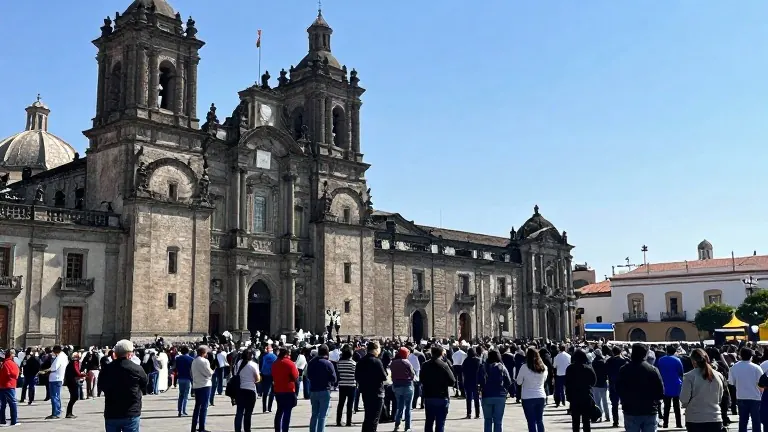
Pope Leo XIV arrived in Buenos Aires on Sunday to face the most politically charged leg of his South American tour. His visit occurs while Argentina grapples with a 32.3% poverty rate and a president who has drastically reduced social spending. The arrival follows a stop in Uruguay, where Leo marked the feast of the Virgin of the Thirty-three in the city of Florida, north of Montevideo.
In Uruguay, Leo became the first pope to visit the country in nearly four decades. He addressed tens of thousands of worshippers in a town of approximately 40,000 residents, noting the Vatican estimate that 50,000 people attended. He focused his homily on the role of women in preserving Catholic faith, acknowledging the pain of mothers whose children no longer practice the religion.
Leo urged these women to continue their efforts despite the challenges. He stated, "Mothers and grandmothers: never tire of passing on the faith!" The crowd included visitors like Fiama Pirez, an English professor from Montevideo, who traveled to Florida specifically so her mother could see a pope. Pirez described the event as a moment of personal rediscovery of her Catholic identity.
The tone shifts in Buenos Aires, where Leo is scheduled to meet President Javier Milei at the airport. Milei, a libertarian, has criticized social justice as an aberration and called public complaints about economic hardship "huge stupidity." His administration has cut the healthcare budget by 48% in real terms since taking office in December 2023. These austerity measures have triggered protests, particularly from students at public universities.
The Catholic Church has voiced strong opposition to Milei's policies. Leo, who selected his name to honor the 19th-century pope who established foundational social teaching, has positioned the poor as a central focus of his ministry. This stance aligns with his predecessor, Pope Francis, who championed the marginalized during his time as archbishop of Buenos Aires. The tension is palpable, as Milei's government portrays the cuts as necessary reforms to eliminate waste and achieve a budget surplus.
Political commentary suggests the visit will test the relationship between the church and the state. Luis Bahamondes, a professor at the University of Chile, noted that Argentina is experiencing deep polarization and economic crisis. He observed that Milei defies conventional protocol, a trait that once led him to challenge Pope Francis. David Lantigua, a theology professor at the University of Notre Dame, expects to see friction between Leo and the current administration, viewing it as a continuation of the ministry Francis left behind.
Milei's sister and secretary-general, Karina Milei, told reporters that the visit is purely religious. She stated that the pope belongs to all Argentines rather than any specific political camp. Meanwhile, posters in Buenos Aires played on the pope's name in Spanish, León, or lion, contrasting it with the lion imagery Milei uses to portray himself on social media. The government also highlighted Leo's warnings about artificial intelligence, an area where Milei has courted investment with promises of limited regulation.
Security concerns have emerged ahead of the papal arrival. Argentina's state intelligence agency reported that a person was arrested on Saturday for making death threats against Leo. A federal court in Campana, located 70 kilometers northwest of Buenos Aires, ordered the arrest less than 24 hours after receiving a tip. The agency did not provide further details on the suspect or the nature of the threats.
Leo's itinerary in Argentina serves to complete unfinished business from the Francis era. The Argentine Jesuit never returned to his homeland during his 12-year pontificate, a decision that confounded many in the country. Leo, who spent two decades as a missionary priest in Peru, will depart for that country after his Argentine stop, bringing his tour to a close in a nation where he ministered to the poor.