New AI tool aims to map ancient Andean empires
A $732,574 grant will help researchers build a searchable database for identifying Wari, Inka, and Spanish structures in South America.
By Marco Kapoor ·
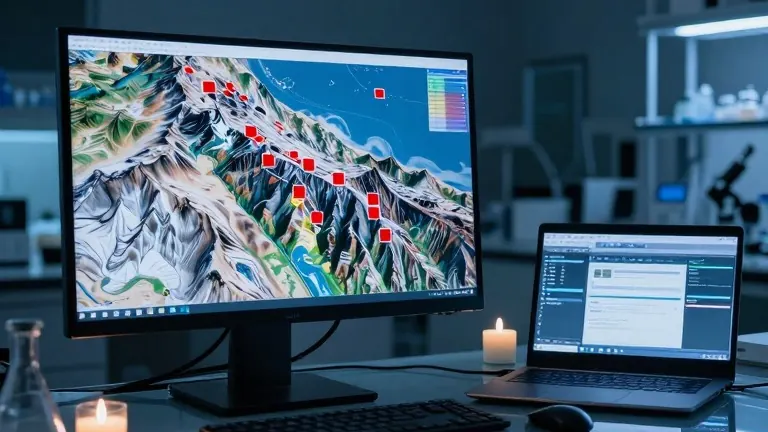
Researchers at Brown University and Vanderbilt University have secured funding to create a new software platform that helps archaeologists identify ancient structures in South America. The tool, named DeepAndes Workbench, uses artificial intelligence to distinguish between buildings from the Wari, Inka, and Spanish empires. This work aims to provide a clearer picture of how these three powers adapted to their local environments and influenced one another over time.
Parker VanValkenburgh, an associate professor of anthropology and archaeology at Brown, co-lead the project with Vanderbilt colleagues Steven Wernke and Yuankai Huo. They received $732,574 from Schmidt Sciences to develop the system. The grant supports the continuation of their previous work, which has spanned more than a decade. This new phase builds on their earlier creation, GeoPACHA, a geospatial platform that uses satellite imagery to map archaeological sites across the Andes.
The new platform will function as an image search engine for archaeological sites. Scholars will be able to upload images or provide verbal prompts to the system. The AI will then identify specific features, such as eighth-century Wari ceremonial buildings or 15th-century Inka imperial structures. VanValkenburgh described the tool as a way for researchers to extend their vision rather than an all-seeing eye that knows everything about Andean archaeology. He noted that expert users will provide feedback on the results, which will help improve the models over time.
The project is expected to produce the first set of continental-scale maps showing how these empires standardized and layered their built environments. This data will allow scholars to see patterns of adaptation across the region. The team is not working alone; they are partnering with approximately 15 collaborators located in the United States, Peru, Chile, and Australia. They are also working with researchers at the Oak Ridge National Laboratory in Tennessee, which conducts research in supercomputing.
Schmidt Sciences is providing the primary funding for the project. The foundation is also contributing in-kind supercomputing resources to support the development. VanValkenburgh explained that the tool models the kind of diverse, question-driven scholarly community that exists in the humanities. The goal is to make these complex archaeological datasets more accessible to researchers who may not specialize in every aspect of Andean history.
The team will use the DeepAndes Workbench to query the agent with various images and prompts. They hope to distinguish specific types of archaeological features that were previously difficult to categorize at scale. The work builds on the foundation laid by GeoPACHA, which has already used satellite imagery to study sites across the Andes. The new grant ensures that this work continues toward a more comprehensive understanding of the region's imperial past.