UK Households Begin Three-Day Supply Reserves
A new government campaign encourages residents to store food and water, with some families already adjusting their shopping habits.
By Christopher Singh ·
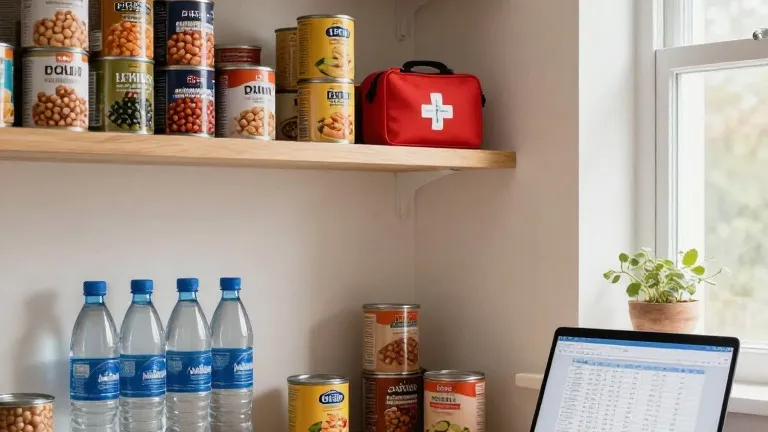
The UK government launched a public campaign on Thursday directing households to store enough supplies for three days. The initiative, titled Be Ready, aims to prepare residents for emergencies ranging from severe weather to geopolitical conflicts. Ministers have issued similar warnings for several months, but the formal launch marked a new phase in national preparedness advice.
Lawrence Barratt of Hythe in Hampshire began building his stockpile two weeks ago. He adds tinned beans, soups, chilli con carne, noodles, and rice to his weekly shopping trips. He is purchasing these items alongside bottled water to ensure he can cook meals for two people during a three-day period. Barratt also keeps a first aid kit, a battery-powered FM radio, a torch, and a portable power bank that he believes can charge phones and run small appliances.
Barratt cited the government's online advice and memories of the 2020 lockdown as primary motivators. He noted that seeing the Be Ready website made him realize he "would be completely unprepared for anything." His approach involves gradual accumulation rather than a single large purchase, allowing him to manage costs and space efficiently in his home.
In Greenwich, London, Marco Camurri is managing a more extensive reserve. His household is collecting pasta, passata, stock cubes, tinned food, bottled water, medicines, and toilet paper. Camurri stated that his family has been preparing for a few months following reports of supply chain disruptions linked to El Niño. He noted that his relatives live in continental Europe, providing an option to leave the UK temporarily if the country enters a state of war or faces extreme infrastructure failure.
Camurri’s family maintains a spreadsheet to track the expiry dates of their stored items, which they refer to as their "Doomsday Stash." They rotate food by eating the oldest items first, a process Camurri described as equivalent to one extra week of staple shopping. The household also keeps power banks charged, stores wood in the garden for heating, and maintains their car fuel tanks above 50 percent capacity, which allows for approximately 300 miles of driving.
Jack Davenport of North Shields on the River Tyne also attributed his decision to stockpile to El Niño warnings. He expressed uncertainty about the scale of threats facing the country, listing climate disasters, Russian shadow threats, artificial intelligence, and interest rate rises as factors. Davenport characterized the UK’s physical and technological infrastructure as "creaking and outdated." He suggested the government aims to "reduce long-term panic" by framing these events as manageable possibilities, noting that several generations have not faced the hardships common before the war.
Not all residents accept the new guidance. Deirdre O’Sullivan of Leicester called the advice "daft," comparing it to 1970s instructions to hide under a table during a nuclear attack. She argued that the three-day target is inadequate for a genuine emergency, suggesting that a real danger to drinking water would be identified more precisely. O’Sullivan believed that an extreme food shortage would become apparent over a much longer period, making short-term stockpiles less practical.
O’Sullivan likened the campaign to a bureaucratic measure designed to show that a policy exists, even if it is not fully effective. She described the guidance as something a fictional civil servant might propose to demonstrate administrative action, highlighting the debate over whether practical reserves or strategic planning better serve public safety.