Chesapeake Pelican Population Halves Since Peak
Researchers link the sharp drop in breeding pairs to declining menhaden stocks, though funding shortages leave the cause unproven.
By Christopher Singh ·
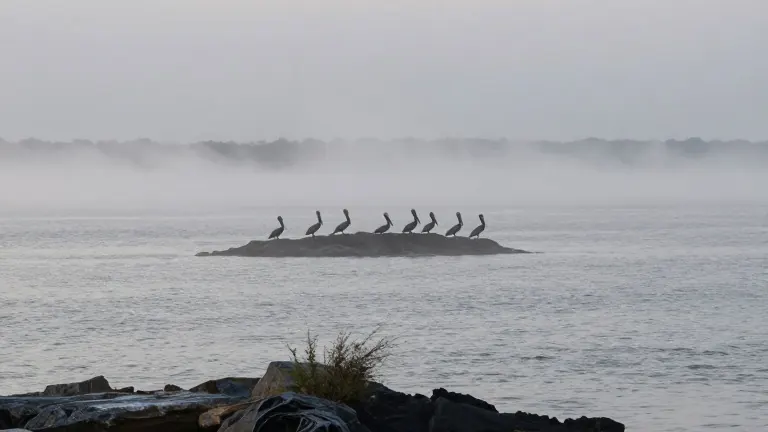
Brown pelican populations around the Chesapeake Bay have fallen by approximately 50 percent from their high point in the late 2000s and early 2010s. Ornithologists report this dramatic decline, yet they lack the funding to determine the precise cause. The leading theory points to changes in the Atlantic menhaden population, a small fish central to a long-running dispute over commercial fishing in the bay.
Dave Brinker, an ornithologist with the Maryland Department of Natural Resources, described the situation bluntly. “They’re going down. That’s the simplest analysis,” he said. After a pause, he added, “I suspect it’s a result of changes in menhaden. We don’t have food studies. But just thinking as an ecologist, [I know] these birds are very sensitive to prey availability.”
The timeline of the birds’ fortunes in the region is striking. In the early 1970s, widespread DDT poisoning drove brown pelicans to the brink of extinction. Following the pesticide ban, numbers surged. By 1987, researchers recorded the first breeding pairs in the Chesapeake Bay. By the late 2000s, the population reached nearly 3,000 breeding pairs. The reversal began in 2023, when a five-year waterbird survey found only 1,500 pairs in Virginia’s portion of the bay. That number represented a nearly 20 percent decrease from the peak a decade earlier.
Bryan Watts, director of the Center for Conservation Biology at the College of William and Mary, leads Virginia’s waterbird survey. He noted that anecdotal reports suggest the decline has continued since the 2023 count. Watts suspects the population is now down 40 to 50 percent. He stated, “The population is definitely pulling back. Is menhaden one of the dominant factors? I suspect that may be one of the factors, but we just don’t have the data to say.”
In Maryland, the drop was equally steep. Breeding pairs fell by more than 50 percent from the state’s 2008 peak by 2023. Brinker, who leads tracking in Maryland, emphasized the local impact over the global population. “My concern is not for the brown pelican population as a whole. There are plenty of places along the Atlantic coast where they can breed,” he said. He added, “What’s a bigger concern is the fact that they did so well when menhaden numbers were higher. Now, menhaden numbers appear to be much lower, and pelicans aren’t breeding so densely in the central Chesapeake.”
The debate over menhaden involves Omega Protein, a Canadian company that harvests the fish to produce oil and meal. Since 2018, a cap has limited the reduction fishery to 51,000 metric tons per year in bay waters. All of that harvest comes from Virginia, as Maryland bans the practice. Federal managers are currently considering lowering that limit following pressure from conservationists and recreational fishing groups.
Omega Protein disputes the connection between its operations and the bird decline. Ben Landry, a company spokesman, said in a statement, “Before there is additional speculation in the media blaming the menhaden fishery, those suggesting a connection should produce peer-reviewed evidence demonstrating that commercial menhaden fishing is responsible.” Landry also pointed to erosion on Shanks Island, a former site for nearly 2,000 nesting pairs, as a documented cause for local abandonment.
Jim Rapp, who leads birding tours to the Smith Island archipelago, confirmed the visual change. “For a while, their numbers dwindled. In recent years, there have been none,” Rapp said. He added, “I would not have had this on my bingo card.” Watts noted that the Shanks Island colony has splintered to nearby islands, though not in large enough numbers to offset the loss.
Reid Nelson, a fisheries scientist at George Mason University, cautioned against jumping to conclusions. He said, “I don’t know that we have the data to support that yet, and I hope that’s where the new research goes.” He noted that some fishery scientists argue there is no solid evidence linking osprey hardships, such as fewer eggs and emaciated chicks, directly to menhaden availability.
Researchers are scheduling further investigation, though resources remain limited. Watts’s research paper on the 2023 survey suggests that birds likely abandoned Shanks Island due to steady erosion. Brinker said there is no research yet to answer whether the missing pelicans starved or migrated to other states.