Peace Board Presses Israel to Open Gaza Aid Gates Amid Winter Crisis
The international oversight body argues that delays in supplying 1.4 million displaced residents are stalling the decommissioning phase of the peace plan.
By Kevin Iyer ·
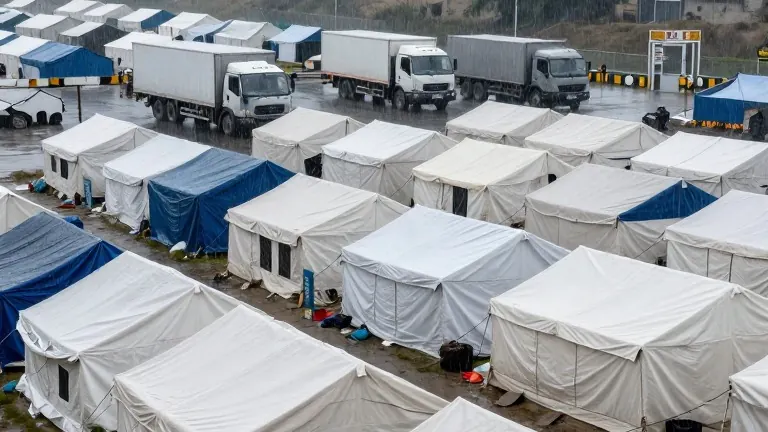
Tensions escalated over the pace of humanitarian aid delivery to Gaza as the Board of Peace demanded immediate access for essential supplies. The international body, tasked with overseeing the implementation of the peace plan, stated that the current response is inadequate for the scale of the crisis. It specifically urged the Israeli government to authorize the entry of goods for temporary shelter and water sanitation infrastructure.
The financial and logistical stakes are high. The United Nations reports that roughly 1.4 million people, or 65% of the population, currently live in tents or makeshift shelters. Over 150,000 tents are already staged outside the territory, waiting for deployment. Despite this stockpile, UN humanitarian coordinator Ramiz Alakbarov noted on Monday that stocks of essential winter items inside Gaza have been exhausted. He warned that time is running out and called for an immediate lifting of entry restrictions.
The dispute centers on the flow of goods and the timeline for military withdrawal. The Board of Peace indicated that delays in approving supplies worsened the impact of the recent floods and slowed the process of transferring authority to a transitional government. In a rare public criticism, the body argued that the Israeli response has not kept pace with the foreseeable humanitarian challenges.
Israel’s military coordination agency, Cogat, defended its position by noting that it has already allowed in tens of thousands of tents and trucks. Under a winter plan coordinated with international charities, Israel brought in more than 91,000 tents and 8,200 trucks carrying blankets, tarpaulins, and clothing. Cogat maintains that reconstruction work can only begin once Hamas has fully disarmed and that equipment with potential military uses will be restricted.
Political blame has shifted between the warring parties. Michal Maayan, a spokeswoman for the Israeli foreign ministry, accused Hamas of hoarding aid and making the winter hardships a direct consequence of its policies. Hamas rejected this view, calling the Board’s comments a distorted account. The group cited a previous statement by Egyptian, Qatari, and Turkish mediators that accused Israel of ceasefire violations. Hamas argued that the Board should examine its own shortcomings as the ceasefire implementor.
The underlying friction stems from the October 2025 agreement to end the two-year war. That deal required Hamas to relinquish governance and weapons in exchange for a phased Israeli troop withdrawal. Israel has insisted that full disarmament is a prerequisite for withdrawal, leaving the next stages of the peace plan stalled. The conflict began after the October 7, 2023 attack, which killed approximately 1,200 people in Israel and led to 251 hostages being taken. According to the Hamas-run health ministry, 74,645 people have died in Gaza since the start of the war, with more than 1,600 killed since the ceasefire took effect.